Insurance for General Contractor: What to Ask in Ontario
Insurance for general contractor work on an Ontario commercial job: the liability, property, auto and WSIB papers to ask for, and the limits contracts set.
Insurance for general contractor work in Ontario is set by your contract, lease and lender, not by a licence: ask for a certificate showing general liability, automobile liability and property cover, plus a WSIB clearance. Then compare every limit with what those documents require before you sign. A missing or short policy is a problem for you, not only the builder.
This guide is for tenants, owners and property managers in Toronto and the GTA who are choosing a builder for an office, clinic, shop, restaurant or industrial space. We explain which policies matter, what a standard Canadian contract asks for, and what to have ready before you call a commercial general contractor. It is general information from public sources, not insurance or legal advice, so confirm the details with your broker and lawyer.
The reason to check early is simple: policy limits are easy to compare in an hour and very hard to fix after something goes wrong. If you are still checking licences and clearances, start with our guide to the license for general contractor question, then come back here for the cover.
What insurance does a general contractor need on a commercial job?
Four kinds of cover come up on almost every commercial contract: general liability, automobile liability, property insurance on the work, and WSIB coverage for workers. Specialty cover, such as pollution liability, is added when the work calls for it.
| Cover | What it answers | What to ask for | Where the limit comes from |
|---|---|---|---|
| General liability | Injury or damage to others caused by the work | Certificate with limit, policy period and who is named | Your contract, lease or lender |
| Automobile liability | Vehicles the contractor owns or leases | Confirmation of limits | Your contract |
| Property insurance on the work | Loss or damage to the work itself while it is built | Who buys it, limits, deductible, who is named | Your contract |
| Pollution liability | Contamination caused by the work | Needed only if your contract asks for it | Your contract |
| WSIB clearance | Workplace injury coverage and premiums | Clearance number, verified online | WSIB, by law |
What limits does a standard Canadian contract ask for?
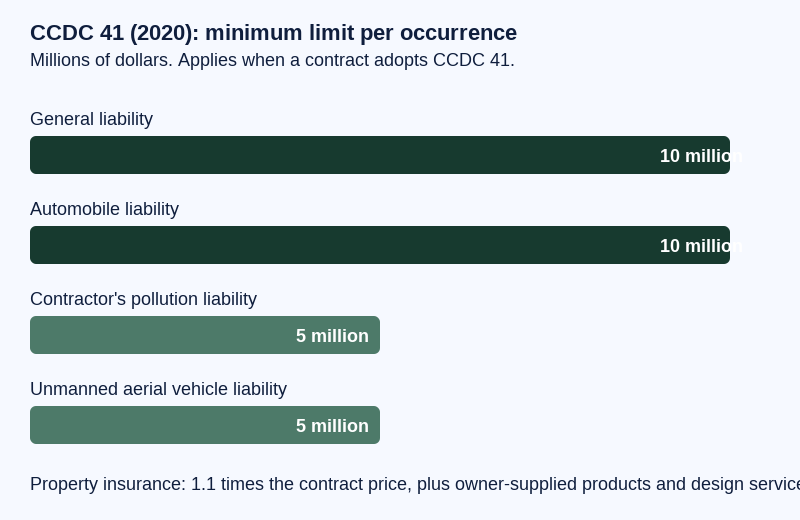
The 2020 CCDC 41 insurance requirements call for general liability of not less than ten million dollars per occurrence, with an aggregate of not less than ten million dollars in a policy year for completed operations and a deductible not exceeding ten thousand dollars. They also say umbrella or excess liability may be used to reach the limit.
The Canadian Construction Documents Committee publishes these requirements for use with its standard contracts. The same document sets automobile liability at not less than ten million dollars per occurrence, contractor's pollution liability at not less than five million dollars per occurrence and, for drones used on the work, unmanned aerial vehicle liability at not less than five million dollars. These are minimums in that document, not a rule for every project. A small tenant job on a private lease may use a different contract, so treat the figures as a benchmark to compare against.
Who insures the building work while it is being built?
Under CCDC 41, property insurance on the work must have limits of not less than 1.1 times the contract price, plus the full value stated in the contract of products and design services the owner supplies. That is a standard of cover for the work in progress, and it is separate from liability cover.
The contract, not the insurance certificate, decides who buys this policy. Ask four questions: who purchases it, who is named on it, what the deductible is and who pays it, and what it excludes. For a tenant, the lease may add a landlord requirement that sits on top of the contract. Our guide on what is leasehold improvements explains why the lease and the build contract need to be read together.
Does WSIB replace liability insurance?
No. WSIB says a clearance is a number that shows a business is registered and up to date with the WSIB, and that clearances are valid for up to 90 days. It also says its protection for a principal covers amounts owed to the WSIB only.
The WSIB clearance FAQ adds that clearances must be in place before any construction work begins and for the duration of the work. A contractor who hires a subcontractor becomes the principal for that work, and must obtain a clearance certificate from the subcontractor first. So you have two jobs: confirm the general contractor's own clearance, and ask how it checks its trades. A clearance tells you the premiums are up to date. It does not tell you the contractor can pay for a flooded unit below yours.
What is the difference between liability and property insurance?
Liability insurance answers claims by other people: a visitor hurt on site, a neighbouring suite damaged by water, a tenant below you. Property insurance covers the work itself: materials, completed work and the building being altered, while it is under construction.
A common mistake is to ask only for a certificate and assume it covers both. A certificate lists the policies, so check that each one you need appears on it, with a limit that matches your contract. If the job is a tenant improvement in a multi-tenant building, the landlord will often add its own rules for contractors, including who must be named on the policy.
What should you check on a certificate of insurance?
A certificate is a snapshot on one date, so read five things on it: the named insured, the policy period, the limit of each policy, the deductible if shown, and whether you or your landlord are listed. Ask for a new one if the build will run past the end date.
- The name on the certificate matches the company on your contract.
- The policy period covers the whole schedule, with a reminder set for renewal.
- The limits meet the contract, lease and lender requirements.
- You and your landlord are named where the contract requires it.
- Subcontractors can show the same kind of proof for their own work.
How does holdback fit with insurance?
Holdback protects against unpaid trades, which insurance does not. The Construction Act says each payer under a contract where a lien may arise must retain a holdback equal to 10 per cent of the price of the services or materials as they are supplied, until the liens that may be claimed against it have expired or been satisfied.
Read it on the Construction Act page on Ontario e-Laws, section 22. The point for this guide is that insurance and holdback guard against different risks, so a contractor with good cover still needs a contract that handles payment properly. Your lawyer should confirm how the holdback applies to your agreement. A construction manager may also ask who carries which cover; our construction management page explains how that role differs.
How does the delivery model change the insurance?
It changes who you ask. With a general contractor and a separate designer, you collect papers from the builder and confirm the design professional's own cover. In design-build construction, one team holds design and construction, so the contract should say how design liability is insured.
Regulated spaces add one more layer. For a clinic, ask whether your college or regulator has rules about the premises, and see our guide to renovating a medical clinic in Ontario. For an office renovation, the landlord's after-hours and building rules usually matter most.
What mistakes do owners make when they check insurance?
Four come up often. Accepting a verbal "we are covered" instead of a certificate. Reading only the limit and not the policy period, so cover lapses mid-job. Forgetting the subcontractors, whose own work is part of the same building. And assuming WSIB, a licence or a bond stands in for liability cover, when each answers a different question.
Another is asking for the highest limit without asking what the contract needs. Requirements that are far above the contract can cost you time in bidding without adding protection. Match the ask to the contract, the lease and your broker's advice.
What should you have ready before calling a contractor?
Gather the lease clauses on contractor insurance, your lender's requirements if any, the address, intended use, size and target date. Then ask every bidder for the same papers so you can compare them.
- Certificate of insurance showing liability, automobile and property cover and the limits.
- WSIB clearance certificate number and dates.
- How subcontractor cover and clearances are checked.
- Whether pollution liability or other special cover is expected for the work.
- Who buys the property insurance on the work and who is named on it.
Ready to ask for a written quote? Contact us with the address, your intended use, the size of the space, your lease insurance clauses and your target dates, and we will tell you what we need next. You can also read about our ICI construction work.
Frequently asked questions
What insurance should a general contractor carry for a commercial project in Ontario?
At minimum, commercial general liability, automobile liability, property insurance on the work and WSIB coverage for its workers. Which limits apply is set by your contract, lease or lender, not by a licence. Ask for a certificate of insurance and compare it line by line with those documents before work starts.
Does WSIB coverage replace liability insurance?
No. WSIB deals with workplace injury coverage and the premiums owed to it, and its clearance page speaks only to WSIB amounts. Liability for damage to your building or to a neighbour is a separate policy. Ask for both papers, because one does not stand in for the other.
What limit of general liability insurance is normal on a commercial contract?
It depends on the contract. The 2020 CCDC 41 insurance requirements that accompany CCDC 2 contracts call for general liability of not less than ten million dollars per occurrence, using umbrella or excess cover to reach it. Your lease, lender or tender documents may ask for more or less, so read them first.
Who insures the building work while it is under construction?
That is set by the contract. Under the CCDC 41 requirements, property insurance on the work must have limits of not less than 1.1 times the contract price, plus the stated value of owner-supplied products and design services. Check who buys it, who is named on it and who pays the deductible before you sign.
Should my subcontractors carry their own insurance?
Yes, ask how the general contractor checks them. WSIB says a contractor who hires a subcontractor becomes the principal for that work and must obtain a clearance certificate from the subcontractor before the work begins. Ask for the same proof of liability insurance from each trade, matched to your contract.
Can a certificate of insurance be wrong or out of date?
Yes. A certificate is a summary on a date, so check the policy period, the named insured, the limits and whether you or your landlord are listed. Ask for a new one if the job runs past the policy end date, and keep the original with your contract papers.
Get a quote for your project
Tell us about the site, the scope, and your timeline. We review it and reply with the next step.